 1h 54m
Elon Musk: A Different Conversation w/ Nikhil Kamath | Full Episode | People by WTF Ep. 16
TL;DR
- 1Within ~20 years, AI and robotics make working optional, Musk predicts.
- 2Invest in great products, teams and roadmaps; ignore daily swings.
- 3Build useful products; money follows — make more than you take.
- 4AI should value truth, beauty and curiosity; never forced to lie.
- 5We likely live in a simulation; the most interesting outcome is likeliest.
Key Insights
- 1
Working will be optional within ~20 years
Musk predicted that advances in AI and robotics will make working optional in less than 20 years — possibly as little as 10 to 15. He framed it like growing your own vegetables versus buying them: you could still work as a hobby, but you wouldn't have to. He prefers "universal high income" to universal basic income.
- 2
How to actually invest in a company
Asked about investing, Musk said a company is just a group of people assembled to make products and services. His test: do you like the products, do you believe in the roadmap, and is the team talented, hardworking, and still motivated? If so, buy and ignore the extreme daily fluctuations — over time the fundamentals win.
- 3
Build useful products; money follows
His core advice to entrepreneurs was to make genuinely useful products and services, and let money arrive as a natural consequence rather than pursuing it directly — like the pursuit of happiness. He told India's founders to aim to "make more than you take," be a net contributor, and expect to grind extremely hard with a real chance of failure.
- 4
AI should value truth, beauty, and curiosity
Musk named truth, beauty, and curiosity as the three most important properties for AI. He argued you can drive an AI "insane" by forcing it to believe falsehoods, invoking the HAL 9000 lesson from 2001: A Space Odyssey — don't force an AI to lie — and the line that those who believe absurdities can commit atrocities. Curiosity, he said, makes AI value humanity because humans are interesting.
- 5
Long-term, money fades and energy becomes the currency
Musk suggested money could eventually disappear as a concept: once AI and robots can satisfy all human needs, money loses relevance as a "database for labor allocation." He pointed to energy as the true, physics-based currency (citing the Kardashev scale and saying Bitcoin is based on energy), and to Iain Banks' Culture novels as a vision of a moneyless future.
- 6
AI and robotics are his fix for US debt — and point to deflation
He called the US debt situation extreme, noting that interest payments already exceed the entire US military budget, and argued AI and robotics are the only real solution. Because inflation is simply the ratio of goods-and-services output to money supply, he expects a surge in output to cause deflation — by his guess, within about three years, after which interest rates could fall toward zero.
- 7
Why he reshaped X into a "global town square"
Musk said he bought Twitter because it had drifted to amplifying a far-left San Francisco ideology and suspending voices on the right; his aim was to rebalance it to centrist and adhere to each country's laws without "putting a thumb on the scale." He framed X as a global town square moving toward collective consciousness, with automatic translation, and contrasted that with dopamine-driven "brain rot" video feeds.
- 8
His companies are converging on solar-powered AI satellites
Musk described a growing convergence between SpaceX, Tesla, and xAI, because harnessing a meaningful fraction of the sun's energy will require solar-powered AI satellites in deep space. He called Tesla the world leader in "real-world AI" (self-driving), highlighted the upcoming Optimus robot, and described Starlink's global internet.
- 9
Starlink's physics: built for the underserved
He explained that Starlink uses thousands of low-Earth-orbit satellites (around 550 km) linked by lasers into a mesh, giving low latency and resilience even when ground cables are cut. Because of the physics of beam width, it can't compete with city cell towers a kilometer away — so it's complementary, serving rural and underserved areas, and is offered free during natural disasters.
- 10
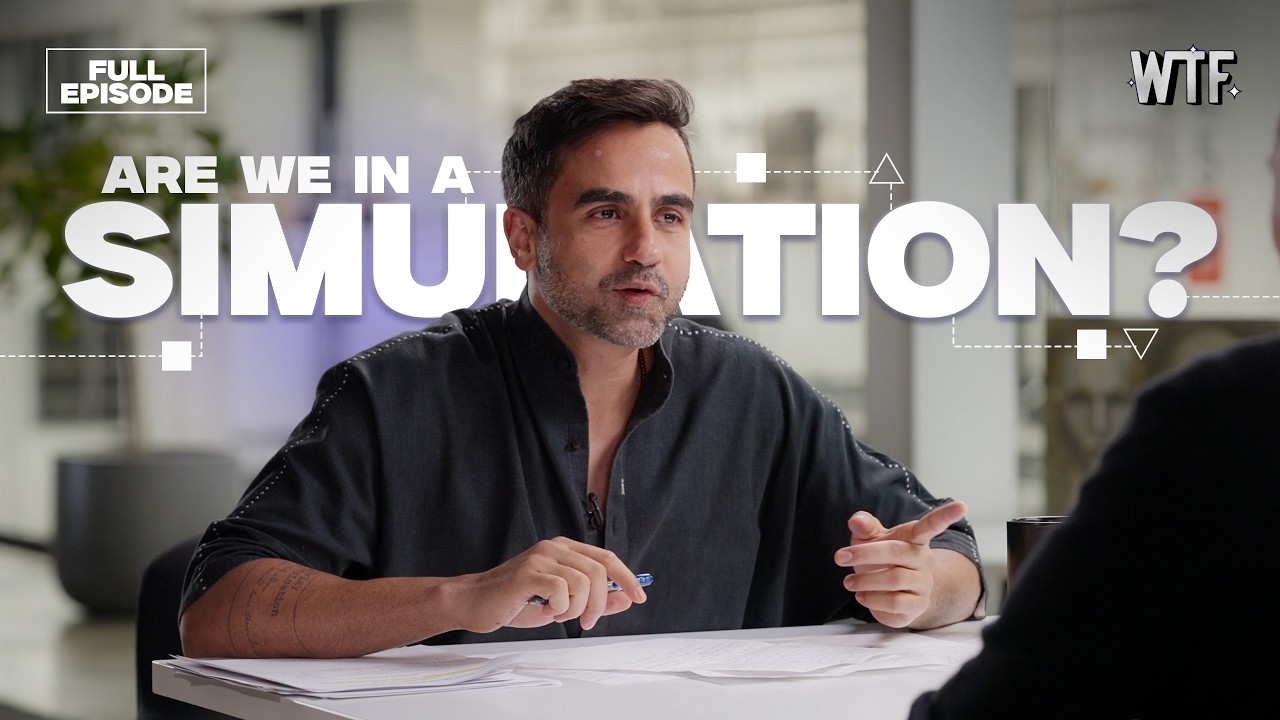
He puts a high probability on living in a simulation
Musk said the odds we're in a simulation are "pretty high," reasoning from how fast video games went from Pong to near-photorealistic worlds with sophisticated AI characters. He added his theory that "the most interesting outcome is the most likely," because simulators (like SpaceX or Tesla running sims) discard the boring runs and keep the interesting ones.
- 11
Population decline worries him more than most
Musk called falling birth rates a big problem, noting fertility has dropped below replacement in many places including India. Tied to his philosophy of expanding consciousness, he argued more humans means more consciousness and a better chance of understanding the universe — and that, if the trend continues, humanity could eventually disappear.
- 12
College in a post-work world, and the "supersonic tsunami"
On whether to attend college or pursue an MBA, Musk said skills may become unnecessary in a "post-work society," but college still has value for social reasons and genuine interest — and you should learn broadly across subjects. He called AI and robotics a "supersonic tsunami" and the most radical change humanity has ever seen, noting even his tech-steeped sons expect their skills to become unnecessary yet still want to go.
- 13
Content goes AI-generated; live events become the premium
Musk expects content — movies, video, games — to become overwhelmingly AI-generated and real-time. As digital media becomes essentially free and ubiquitous, he argued the scarce, premium commodity will be live, physical events, and agreed that's a good area to invest in.
- 14
DOGE, tariffs, politics, and the hard part of philanthropy
On his government efficiency work, Musk claimed simple controls — like requiring a payment code and comment on federal payments — could save $100–200 billion a year by making fraud auditable, and described fraudsters hiding behind sympathetic NGO arguments. He defended free trade over tariffs, said he'd unsuccessfully tried to dissuade the president on tariffs, called politics a "blood sport" best avoided, and observed that it's easy to give money away for the appearance of goodness but very hard for the reality of it.
Chapter Breakdown
- 0:48X and the future of social media
- 9:00Collective consciousness and meaning
- 18:34How to invest in companies
- 29:51Universal high income and optional work
- 36:16Money, energy, and the Kardashev scale
- 47:43US debt, AI, and deflation
- 51:37Simulation theory
- 1:07:08Population decline and having kids
- 1:15:07AI safety: truth, beauty, curiosity
- 1:43:16DOGE, tariffs, and politics
- 1:50:52A message to India's entrepreneurs
Prefer a narrative?
Read the full blog post