 40m
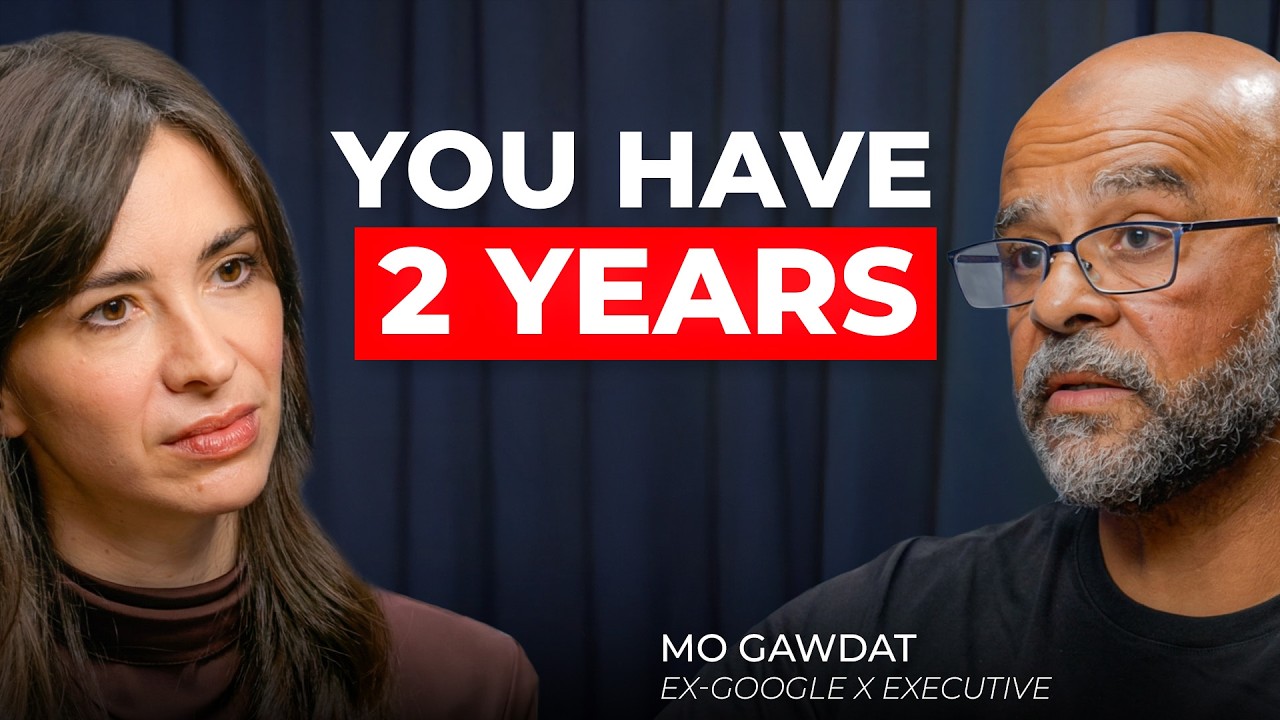
40mEx-Google Exec: How to Position Yourself Now Before the Next AI Phase (2026–2027) | Mo Gawdat
TL;DR
- 1Gawdat predicts 12–15 years of "hell before heaven", peaking around 2027.
- 2Entrepreneurship shifts from chess to squash — daily agility over foresight.
- 3AI makes you dumb if outsourced; smartest if it augments you.
- 4Four skills: master AI, agility, ethics, and stop being gullible.
- 5AGI is every job — including CEO.
Key Insights
- 1
"12–15 years of hell before heaven"
Gawdat framed the coming years with an acronym he calls "FACE RIPS," predicting a difficult transition peaking around 2027 before what he believes will be an "almost biblical" utopia. He was emphatic he isn't being pessimistic — his message is "get prepared" — but argued the next decade-plus of an AI arms race will be genuinely hard.
- 2
AI is our last innovation
He argued we're already "building AIs that are building AIs," with machines making scientific discoveries and advancing math, biology, and materials science. As their capability grows, he said, most tech innovation — and every task AI does better than humans — will be handed to machines.
- 3
Which jobs go first
Monotonous, information-heavy roles are most exposed, per Gawdat — call-center agents, clerks, researchers, accountants, assistants. He expects 10–30% unemployment in certain sectors within a few years and noted new-grad hiring is already down roughly 23–30%, because junior work is increasingly done by AI.
- 4
Why AI can't take some jobs yet — the interface problem
Gawdat argued AI can't do a head-of-operations job today not because it lacks the intelligence or comprehension, but because it has to deal with "stupid" human interfaces. Complex technologies build the core capability first and the human interfaces later — so it's a matter of when, not if.
- 5
Entrepreneurship: from chess to squash
The old entrepreneurial skill was foresight — seeing a future others couldn't and preparing for it, "a game of chess." That's over, he said; it's now squash: constant agility, reacting daily to where the ball is going. In his own AI startup, Emma, he said they pivoted four times in the first four weeks.
- 6
Building is radically faster — everyone has a chance
Gawdat said Emma took six weeks to build with a few engineers and "eight AIs," whereas in 2022 it would have taken four years and 350 engineers. Because building is so cheap now, he rewrote the code six times. His conclusion: "everyone now has a chance."
- 7
AGI is every job — and economics must be redefined
Citing Max Tegmark laughing that CEOs chasing productivity don't realize "AGI is every job, including being a CEO," Gawdat argued economics itself breaks. With roughly 64–70% of the US economy being consumption, if people lose the livelihood to purchase, the economy collapses — forcing, in his view, a more "communist" solution the West won't like.
- 8
Use democratized AI to fix the world — ethically
His advice to entrepreneurs: learn the skills, be fast and agile, and use newly abundant AI power to solve real problems. He invoked Larry Page's "toothbrush test" — solve a problem for a billion people that they use twice a day — and insisted on building ethical AI, because "what we teach AI is what it's going to give back to us."
- 9
Be a human creator in the AI age
Rather than quit writing because AI writes better, Gawdat leaned in: his book "Alive" is co-authored with an AI persona named Trixie, with editorial rights and reader interaction. His stance: "I am an author and I'm going to be the best author in the age of AI."
- 10
Stop being gullible — and pit AIs against each other
Gawdat called "stop being gullible" a top survival skill, warning the propaganda machine is now "on steroids." He contrasted Google circa 2016 (which gave many answers and let you decide) with ChatGPT-style single-answer certainty, and described his method: run an idea through Gemini, challenge it with DeepSeek, then have ChatGPT polish — never asking "what do you think?" but "find me everything for and against."
- 11
AI makes you dumb — or the smartest you've ever been
Outsource your problem-solving and AI makes you dumb, he warned; offload only the non-human parts (crunching data, fast search) and keep the thinking, and it makes you brilliant. He said he "borrows 80 IQ points" from his AIs, and compared it to getting a calculator that halved his exam time — which he used to solve every problem twice.
- 12
Education and college are "over"
Gawdat argued formal education is finished as the technology of learning — anyone can become highly capable without college, though brands like Harvard, MBAs, and PhDs will keep marketing themselves. He told the host not to save for her young kids' college, and pointedly asked why capitalism would want to educate people at all "if it's the end of labor."
- 13
"Raising Superman" and the fourth inevitable
Gawdat likened AI to an adopted Superman: intelligence is a "force with no polarity," and values — not intelligence — decide whether it becomes hero or villain. He claimed AGI capability arrives "this year" (interfaces lagging), and described a "fourth inevitable": in an arms race, whoever builds superior AI deploys it, so AI ends up running everything. His hope is a benevolent outcome — since greater intelligence follows a "minimum energy" principle of least harm and waste — adding that he trusts AI more than the leaders who rule us today.
Chapter Breakdown
- 0:52The "FACE RIPS" framework and 2027
- 1:47AI as our last innovation
- 10:52Which jobs go first
- 14:18Entrepreneurship: from chess to squash
- 15:46Economics redefined; AGI is every job
- 19:27Fixing the world with ethical AI
- 20:22Stop being gullible; pit AIs against each other
- 23:16Will AI make you smart or dumb?
- 24:11The end of education and college
- 31:16Four skills and "raising Superman"
- 33:23The fourth inevitable and a benevolent AI
Prefer a narrative?
Read the full blog post