 12m
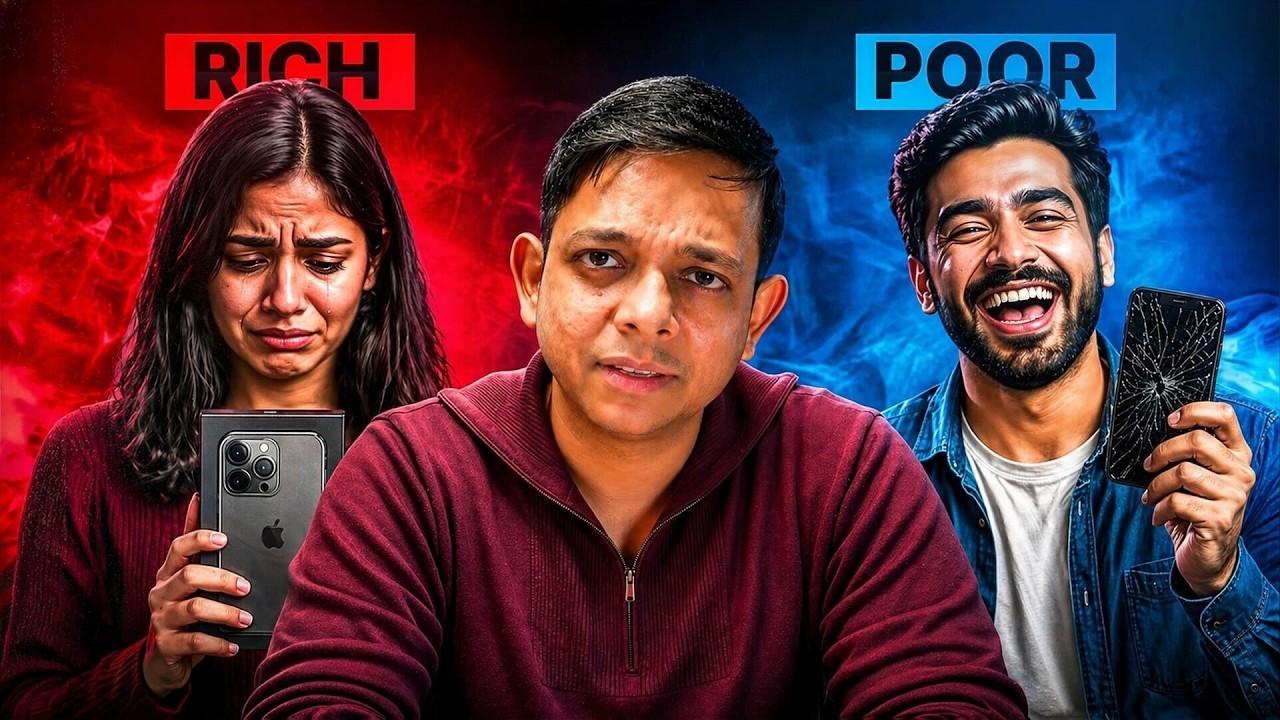
12mHarsh Truth about Money Nobody wants to hear
TL;DR
- 1Money buys happiness only up to a point — then the returns diminish.
- 2Newer research finds no clear saturation point; the data stays gray.
- 3Lottery winners and accident victims both return to baseline within ~18 months.
- 4The hedonic treadmill resets your happiness baseline with every gain.
- 5Spend on experiences, not things — and choose to focus on the good.
Key Insights
- 1
The Nobel study: money equals happiness, up to a point
The host anchors the episode on a study by two Nobel Prize winners covering 4.5 lakh respondents, which concluded that money does equal happiness — but only up to a point, after which the returns on happiness diminish. In the US, that saturation point was roughly $75,000 a year, which he converts to about ₹1–1.5 lakh per month in India on a PPP basis. Beyond it, more money yields steadily less additional happiness.
- 2
The counter-evidence: maybe there's no saturation point
True to Zero1's habit of trying to disprove its own conclusions, the team went looking for holes. India's GDP has risen sharply — the country is richer — yet, per that report, not statistically happier. They then found another paper arguing there is no saturation point at all. Across India, the US, Europe, and Australia, the host says, there's no black-and-white answer; the data stays "gray."
- 3
The 1978 lottery-vs-accident study: everyone returns to baseline
Turning from data to real lives, he cites a 1978 study comparing two extreme groups: lottery winners who suddenly got rich, and accident victims who were paralyzed and lost everything. The paralyzed group was sadder than a control group in the moment, but rated their expected future happiness as roughly normal — they returned to baseline. The lottery winners were happy at first, but after about 18 months their happiness, too, had returned to normal.
- 4
The hedonic treadmill explains why
The mechanism, he explains, is that the brain is designed to normalize its environment — a phenomenon called the hedonic treadmill. Aspiration says "if I get this, I'll be happy," and you genuinely do feel happy when you acquire it. But scientifically, the joy from any material thing fades back to normal after a while.
- 5
"Weird stairs" and lifestyle creep
He reframes the treadmill as a staircase: every gain — say a 20% raise — lifts you briefly, then becomes your new, higher baseline, from which you want the next increase. This drives lifestyle creep: when income rises 20%, spending rises 20% too. The result is that the happiness is short-term, and there's no enduring joy, because good and bad times arrive regardless.
- 6
The ECV framework: buy experiences, not things
His answer is what he calls the ECV framework, drawn from a researcher's paper on whether "to do or to have" and, playfully, from a Maroon 5 concert. The core finding: when you buy something, the pleasure of owning it drops over time, whereas experiences last far longer in memory. A five-day vacation, he says, stays with you longer than owning a phone for five years — so money can buy happiness if you spend it on experiences.
- 7
The Maroon 5 story as proof
To illustrate, he recounts taking his wife Swati to Maroon 5 in Mumbai for their 15th anniversary. They'd bought the most expensive platinum-lounge tickets — unlimited food and drinks, but far from the stage — and chose to abandon that comfort to stand in a lower tier close to the stage purely for the experience. It became an unforgettable night: he made friends who held their spot while he fetched drinks, and Swati was unexpectedly pulled into the pit to party near the stage.
- 8
Life is events you don't control — focus is the lever
Finally, he argues your life is made of events, most of them outside your control — good, bad, and neutral, arriving all at once. What you can control is focus. Some people fixate on the "reds" (the bad events) and constantly complain; others focus on the "greens" (opportunities and good things) despite real problems, and carry higher energy and more contentment. His closing question: is happiness a choice? His parting advice: be grateful.
Chapter Breakdown
- 0:00"Money can't buy happiness," revisited
- 0:42The three questions
- 1:25The Nobel study: happiness up to a point
- 2:09The counter-evidence: no saturation point
- 2:42The 1978 lottery vs. accident study
- 4:24The hedonic treadmill
- 5:07"Weird stairs" and lifestyle creep
- 6:05The ECV framework: experiences over things
- 6:29The Maroon 5 story
- 10:01Life is events — focus and gratitude
Prefer a narrative?
Read the full blog post