 40m
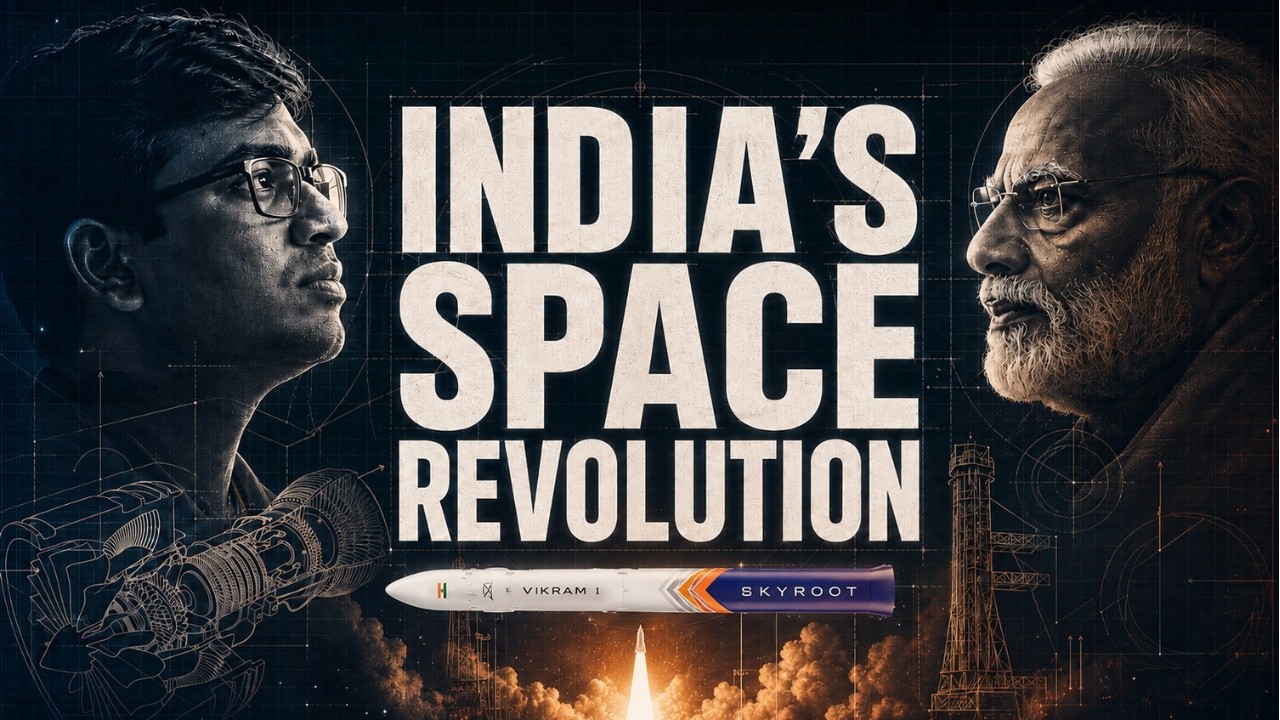
40mHe Quit ISRO To Start An Illegal Rocket Company | The SKYROOT Story ft. Pawan Kumar Chandana
TL;DR
- 1Two ex-ISRO engineers built Skyroot when private rocket launches were illegal in India.
- 2Skyroot is the 'Uber to space' — booking whole rockets to custom orbits.
- 3Falling launch costs will spawn new industries, including AI data centers in space.
- 4Building a small rocket is harder than a big one — you optimize in grams.
- 5Building a rocket is never a capital problem; it's about the founders.
Key Insights
- 1
An "illegal" rocket company
In 2018, Pawan Kumar Chandana and his co-founder Bharath quit safe, respected ISRO jobs to start Skyroot — at a time when private rocket launches were still illegal in India, with no enabling policy, no space-investment thesis, and no private-sector talent. His counterintuitive logic: "Building a rocket company is far easier when nothing is there." The empty field, he decided, was the opportunity.
- 2
Why the world went "gaga over space"
Chandana attributes the launch boom (SpaceX flew 165 rockets in a year) to exploding demand — communication satellites beaming internet to billions and earth-observation satellites feeding many industries — combined with collapsing costs. He compares it to solar, which fell from ₹200 per watt in 2010 to about ₹10 per watt in 15 years, and says rockets are following the same curve through reusability.
- 3
Falling launch cost is a foundational shift
Just as cheap internet spawned entire industries, Chandana argues that dropping launch cost from around $2,700 per kg toward $100 per kg will create industries that don't exist yet. His headline example is AI data centers in space: you get 7–8x more energy per unit area, 24x7 solar exposure in the right orbits, no water for cooling, and no land to acquire — viable once launch costs fall to a few hundred dollars per kg.
- 4
What makes ISRO special
Chandana calls ISRO India's only true deep-engineering organization, building rockets like PSLV, GSLV, and LVM3 entirely from scratch. He's effusive about its record: the first country to reach Mars orbit on its first attempt, the first to land near the Moon's south pole, and the most frugal space program in the world — reaching Mars for less than the budget of the movie "The Martian," with a cumulative budget smaller than a single year of NASA's.
- 5
The values Vikram Sarabhai instilled
He credits ISRO's culture of "scientific temper": obsessive attention to detail (a single bolt can bring down a whole rocket), the highest integrity — where failures are openly discussed and accepted as part of development — a national spirit of doing it for the country, and an extreme frugality born of scarce resources.
- 6
The "lightning strike" that became Skyroot
Chandana was on the team that developed India's largest rocket, LVM3, and worked on its first successful missions — including the one that landed a spacecraft near the Moon's south pole. He planned to retire at ISRO until a sudden thought struck: why can't India have a private rocket company? Skyroot became the first company to sign an MOU with ISRO for test-facility access, and the enabling policy arrived in two to three years rather than the decade he'd braced for.
- 7
The business model: high-tech logistics to space
Skyroot, Chandana explains, is essentially "a logistics company to space" — it launches rockets that carry satellites to orbit, and the satellite companies pay for the transportation. Those customers, in turn, make money through communications (connecting regions with no other link) and earth observation, a market he says is heading toward $30 billion by the end of the decade.
- 8
What earth-observation satellites actually do
He runs through a startling range of applications: defense surveillance (radar satellites that image 24x7 through clouds and darkness); precision agriculture (cameras sensitive to 0.1-Kelvin differences that reveal exactly when and how much to irrigate — and can even detect pests from space); ISRO's "Potential Fishing Zones" that save fishermen billions in fuel; instant insurance payouts verified by satellite imagery; and even loan disbursals checked floor-by-floor as a house is built.
- 9
Skyroot as the "Uber to space"
While SpaceX and ISRO build big rockets — "trains and metros" running hub-to-hub to the most popular orbits — Skyroot lets a customer book an entire small rocket to a customized orbit for maximum coverage and ROI, a premium service he says only one 20-year-old US company offers. It targets the sub-300kg small-satellite market (satellites have shrunk from room-sized to mini-fridge-sized, much as smartphones did), with a rocket version scaling up to a one-ton capacity.
- 10
Small rockets are harder than big ones
Counterintuitively, Chandana says building a small rocket is tougher because "gravity is brutal" — you must optimize in grams, with no room to add thickness, components, or redundancy. But it's the right first step: a big rocket needs roughly half a billion dollars to develop, whereas surviving the small-rocket journey prepares you to build big far faster. At up to ₹100 crore per launch, he notes, 20 launches is ₹2,000 crore.
- 11
How he raised money — by Googling it
With ambition but no money and no idea how fundraising worked, Chandana literally Googled "what is a term sheet," initially assuming an investment might be a loan before learning it meant exchanging shares for capital. Lacking any contacts, a friend cold-pinged Myntra and Cult.fit founder Mukesh Bansal on LinkedIn; Bansal replied immediately, met them in Bangalore the next day, and committed ₹10 crore in under an hour. The pitch, Chandana says, was essentially "nothing" — two people quitting safe jobs to take a bold risk on strong Indian fundamentals.
- 12
Building a rocket is never a capital problem
Chandana insists you can throw all the money in the world at a rocket company and still fail — success comes down to the founders' energy, execution, and "infectious passion." That's why Skyroot's early investors were all entrepreneurs: you can't calculate the bet, so you back people who will pivot through any crisis. He points to Rocket Lab's Peter Beck — no formal education, from a country with no space program — building one of the world's largest space companies in 20 years.
- 13
His advice, and the mission
To a 23-year-old, Chandana's message is to take the leap and start something, because India needs bold deep-tech founders building aircraft, drones, robotics, nuclear fusion, biotech, and space — not just delivery apps and "fancy ice creams." Education, he argues, is now nearly free (ChatGPT, Claude, podcasts) and "the best people in the world are self-taught" — he was a last-bencher who studied "two or three layers deep" on his own. Skyroot's mission is to "open space for all," because he believes becoming a space-faring civilization is ultimately the only way to scale humanity beyond a finite Earth.
Chapter Breakdown
- 0:00India's first private rocket, and an "illegal" start
- 4:03Why the world suddenly went gaga over space
- 5:12Falling launch cost and AI data centers in space
- 8:54Quitting ISRO to start something illegal
- 11:26What makes ISRO special
- 12:39The values Sarabhai instilled
- 13:53The "lightning strike" that became Skyroot
- 16:22The business model: logistics to space
- 17:05What earth-observation satellites do
- 21:02The "Uber to space" niche
- 24:09Why small rockets are harder
- 26:08Raising money by Googling it
- 29:10Three space domains for investors
- 33:36Advice to a 23-year-old, and the mission
Prefer a narrative?
Read the full blog post