 3h 14m
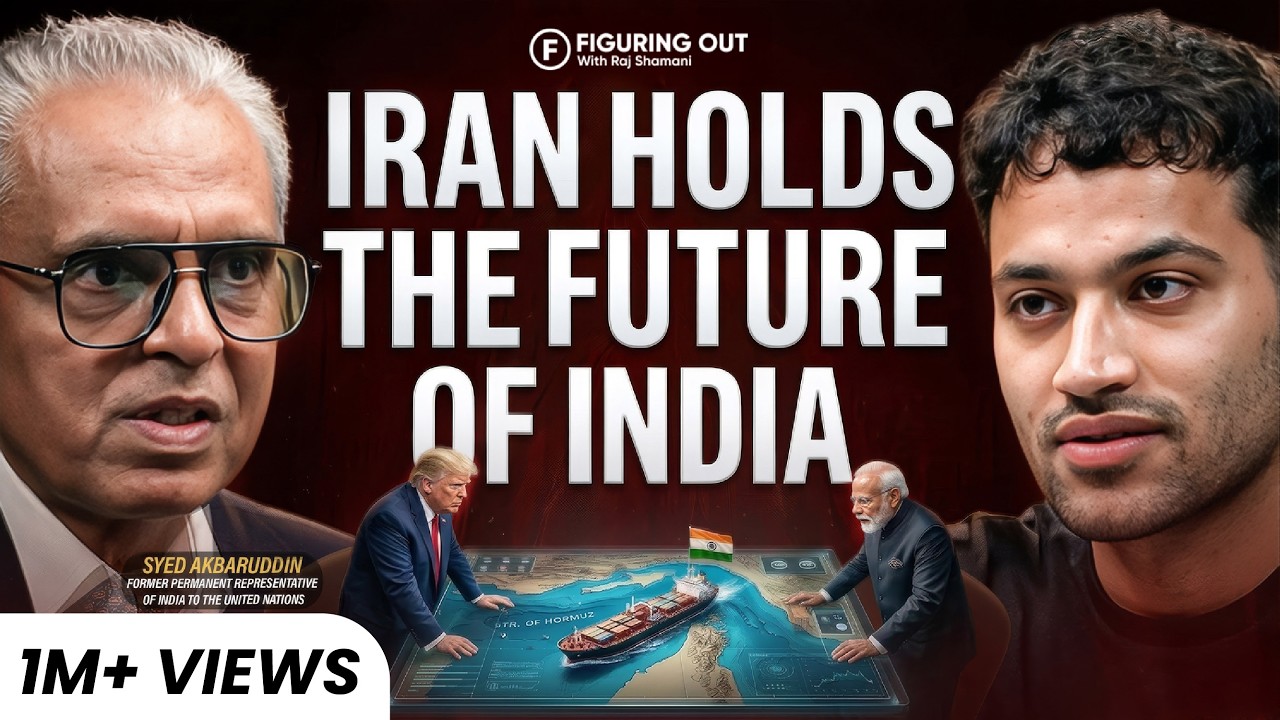
Indian Diplomat Explains: India vs US vs China & Trump | Syed Akbaruddin | FO491
TL;DR
- 1India engages every rival — Iran and Israel, US and Russia — without entanglement.
- 2Foreign policy is now interest-driven and calibrated, not doctrine or moral commentary.
- 3On Pakistan: no mediators, back channels only, handle terror threats ourselves.
- 4China, not Pakistan, is India's real long-term challenge — economic and civilizational.
- 5India's rise is structural; 'silence is strategy,' so reduce vulnerabilities at home.
Key Insights
- 1
What a diplomat actually does today
Akbaruddin explains that the job has expanded from the 1980s, when it was largely observation and soft power — he recalls piggybacking on Amitabh Bachchan's stardom to promote India in Egypt — into a multitasker's role. Today a diplomat serves a vast diaspora (2.5 million Indians in Saudi Arabia alone), promotes trade and investment, smooths remittances (India is the world's largest recipient, at $125–130 billion), signals India's global positions, and represents India as a "civilization state."
- 2
Everything is interest, nothing is emotion
The core operating principle he returns to repeatedly: states act on interest, not sentiment. Diplomats are "frenemies" who "trust but verify," and even 100% truth is accepted only if interests align. He notes young Indians increasingly want foreign policy to deliver jobs, visas, and opportunities — a transactional lens he considers fair, not shallow.
- 3
Serving in Pakistan means observation under surveillance
Akbaruddin describes Pakistan as one of the hardest postings — constant intrusive monitoring, stress on diplomats' families, and a state he calls a "master in deceit and deception." Its core ideology, he argues, is that Pakistan cannot flourish if India flourishes. He frames Pakistan as India's "rearview mirror": a persistent security concern, but a country India has economically and strategically left behind and should stop obsessing over.
- 4
India–Pakistan has only two parties — no mediators
On the ceasefire, Akbaruddin is emphatic that it is a doctrinal principle that no outside party mediates India–Pakistan matters. Countries like Saudi Arabia, the UAE, Qatar, and the US passed messages, but relaying communication doesn't make them mediators; the initiative and final decision, he says, were India's alone. Front-channel talks have failed for 25 years; realistic progress comes through deniable back channels, with no formal dialogue until terror stops.
- 5
Winning an ICJ seat against a permanent power
He recounts India's win of an International Court of Justice judgeship — the first time a non-permanent UN member beat a P5 country (the UK). The push was triggered by the Kulbhushan Jadhav case, and victory came from expanding beyond Asia to court African and Latin American votes, plus the full weight of India's diplomatic machinery. He describes the UN's structural flaw bluntly: the five permanent members "scratch each other's back."
- 6
How India got Masood Azhar designated — by going loud
After years of Chinese blocks, Akbaruddin says India's 2019 breakthrough came from a procedural threat: forcing an open Security Council vote so China would have to publicly defend its "hidden veto." Preferring to operate quietly, China calculated the reputational price was too high and relented. He argues such incremental, narrative-level wins matter even when they don't dismantle terrorism outright.
- 7
Why no country is legally a "terrorist state"
Asked why Pakistan is never formally designated a state sponsor of terror, he explains that in international law terrorism is defined as an individual or group crime — a sovereign, even a despotic one, cannot legally be a terrorist. The entire counterterrorism architecture targets individuals and groups, which is why the "terrorist state" label effectively exists only in US designations.
- 8
The balancing act: engaged, but not entangled
India is friends with mutual enemies — Iran and Israel, the US and Russia. Akbaruddin explains the logic through interests: Iran is India's gateway to Central Asia (via Chabahar) since Pakistan blocks the western land route, but the Gulf carries far larger stakes ($200 billion in trade, 10 million Indians), which is why India was more vocal defending the Gulf than Iran. His formula: "engaged with both, without getting entangled."
- 9
Interests over doctrine — and the price of neutrality
India didn't condemn strikes on Iran while sending it humanitarian aid, because its larger interests (Gulf oil, remittances, diaspora) outrank abstract principle — and he notes 130+ countries calibrated similarly at the UN. The price of this non-alignment, he concedes, is that no one backs India either (as during recent operations against Pakistan). But he argues India's consistent 70-year position is that it doesn't want the world's help on Pakistan; its outreach was preemptive signaling, not a plea for support.
- 10
From "poorer but louder" to "wealthier and more guarded"
Akbaruddin frames a generational shift: India's economy went from roughly 15% linked to the world in the 1980s to about 50% today, so it can no longer afford to be the loud, reflexive critic it once was. Silence, he argues, is a strategy, not weakness — and foreign policy should be judged by whether Delhi can "reduce exposure without surrendering agency."
- 11
The vulnerability critique he takes seriously
Pressed that India's exposures have grown — energy dependence on Russia (from ~1% to ~33%), technology and semiconductors on the US, capital on China — Akbaruddin concedes the point but argues it's a mid-transition snapshot. Growth isn't linear; the answer is to build foundations now (solar, nuclear) to cut dependence later. He calls energy India's clearest weakness, and notes India is scaling in a harder era than China faced 25 years ago, with tighter capital and rising export barriers.
- 12
Is the US India's "boss"? No — but great powers carry hubris
He rejects the idea that India follows US orders, pointing to India refusing US requests on Ukraine votes, continuing Iran negotiations over US objections, and declining to join Trump's "board of peace." Great powers develop "hubris" — the US style is "my way or the highway" — but the unipolar moment (roughly 1991–2007) is over. He cautions against mistaking style for substance, describing India's own style as "hard-headed, but not showing it openly."
- 13
China is the real long-term challenge, not Pakistan
Akbaruddin is clear that China, not Pakistan, is India's defining foreign-policy challenge. China sees India's rise as a threat on two fronts — economic (the "China plus one" shift) and civilizational (India is the one culture that can rival Chinese soft power) — and it out-invests India across the neighborhood with "deeper pockets." India can't confront China directly, so it works out a "via media" while ensuring China cannot impede its rise. "If there's one foreign policy challenge, it is to ensure our growth is not impeded by China."
- 14
On the UN, a permanent seat, and India's balance sheet
He defends flawed international bodies with a memorable line: the UN was built not to bring "heaven" but to prevent a descent into "hell" — a world war among great powers — and the P5 veto is a deliberate design flaw. India seeks to reform the order, not revolt against it, because "if you're not on the table, you're on the menu." He names financial inclusion and UPI as India's best decision of the decade — a global export the world still underestimates — and political polarization (delaying reforms like women's reservation) as the worst. India's biggest diplomatic strength, he concludes, is access to every global decision-maker; its biggest weakness is the economic vulnerabilities it must fix at home.
Chapter Breakdown
- 0:00What a diplomat actually does
- 5:54How the role expanded since the 1980s
- 19:26Crisis management and evacuations
- 27:50Everything is interest, not emotion
- 33:01Serving in Pakistan
- 41:26The ceasefire: two parties, no mediators
- 48:43Winning an ICJ seat against a P5 power
- 1:00:07Masood Azhar and China's hidden veto
- 1:18:02The balancing act: Iran, Israel, the Gulf
- 1:29:05Interests over doctrine — and its price
- 1:40:00"Poorer but louder" to "wealthier and guarded"
- 2:00:40Is the US India's boss? Styles of great powers
- 2:15:09China: the real long-term challenge
- 2:40:39Are international bodies useless?
- 2:57:21Best and worst decisions of the decade
Prefer a narrative?
Read the full blog post