 44m
44mKhan Academy CEO: The Real AI Opportunity Is in Boring Industries | Sal Khan
TL;DR
- 1Sal Khan's new book 'Job Shock' warns AI's job dislocation needs a real plan.
- 2Call centers and driving go first; product roles are blending and changing.
- 3Safe jobs lean into the human element — teaching, nursing, sales, hospitality.
- 4His $10k Content Institute credentials 'durable skills' over GPA for employers.
- 5The real opportunity: boring industries and empty lanes, not the AI crowd.
Key Insights
- 1
From optimist to worried — the "Job Shock" turn
Sal Khan, who admits most of what he's ever said tends to be optimistic, says he's now genuinely worried, which is why his next book is titled Job Shock. Its genesis was a New York Times op-ed arguing that society can't simply assume "the industrial revolution turned out okay" — that era also brought the bloodiest century, world wars, and experiments with communism. His point: AI's disruption demands an actual plan, not blind faith in history.
- 2
The call-center wake-up call
The moment that shook him: a VC friend told him one portfolio company had automated 80% of a Philippines call center — hundreds to thousands of jobs — with a generative-AI solution. Khan notes that business process outsourcing, mostly call centers, is 5–7% of the Philippine economy, making it an early, concrete signal of dislocation likely to spread over the next three to five years.
- 3
Driving is next, and it's political
Khan expects a "real dent" in driving and ride-share jobs within five to ten years — slower than AI evangelists claim, but still fast. Because driving is one of the largest employers of men globally, he warns that mass unemployment among angry men (and women) will spill into politics, drive polarization, and push people toward extremes.
- 4
The endangered jobs: call centers, drivers, and product roles
Beyond drivers and customer support, Khan says "the writing is on the wall" for software engineering, design, and product management — roles that are fundamentally changing and blending together, even at Khan Academy. The people most at risk, he stresses, are those who don't want to adapt.
- 5
The safe jobs lean into the human element
The safest work, Khan argues, is anything rooted in human connection. He names teaching (moving up the value chain from "sage on the stage" to planner, coach, and motivator), nursing, hospitality, and relationship-based sales, where being a trusted, straight-shooting adviser matters. Anything done purely on a computer, with no human interface, is under threat.
- 6
Why AI won't cause layoffs at Khan Academy
With 350 staff (two-thirds in product), Khan Academy's team worries that 3x productivity means two-thirds get cut. Khan's answer: "If we could do three times more with the same resources, we will do three times more" — layoffs come from a lack of philanthropy or revenue, never from AI. But he's added "learning new tools and adapting" to the company's career rubric.
- 7
Inside the stack: agents, sticker shock, and 50–100% velocity
Khan Academy engineers run five to ten coding agents simultaneously, and Anthropic reportedly ranks them among its biggest users of code-review agents. Their Anthropic bill runs about $1.2 million a year for roughly 200 engineers; one engineer spent $3,000 of compute in a day to do what would normally take three to four months. Khan says the organization now feels 50–100% faster and is accelerating — a feature once slated for "next school year" was vibe-coded in a day and shipped in a month.
- 8
AI as a chief of staff
With connectors approved for Slack, Gmail, and docs, Khan uses AI daily to ask "what's falling through the cracks?" — treating it like a chief of staff that drafts replies and surfaces neglected tasks. Proposals that once took one to two weeks now have a first draft within ten minutes of a meeting. His rule: keep a human in the loop, let it draft but not send, and always verify sources (he checks for an IRS.gov citation) before publishing.
- 9
Why a nonprofit isn't afraid of being cloned
Asked if AI could just build another Khan Academy, Khan gives two answers. His "ego" response: yes, he worries, and it's plausible in three to five years. His "correct" response: as a nonprofit, if someone builds something as good or better and proves it, that's a world problem solved — celebrate it. The real moats, he adds, are efficacy data, rigorous psychometrics, and school-system relationships that are hard to "vibe-code in a garage."
- 10
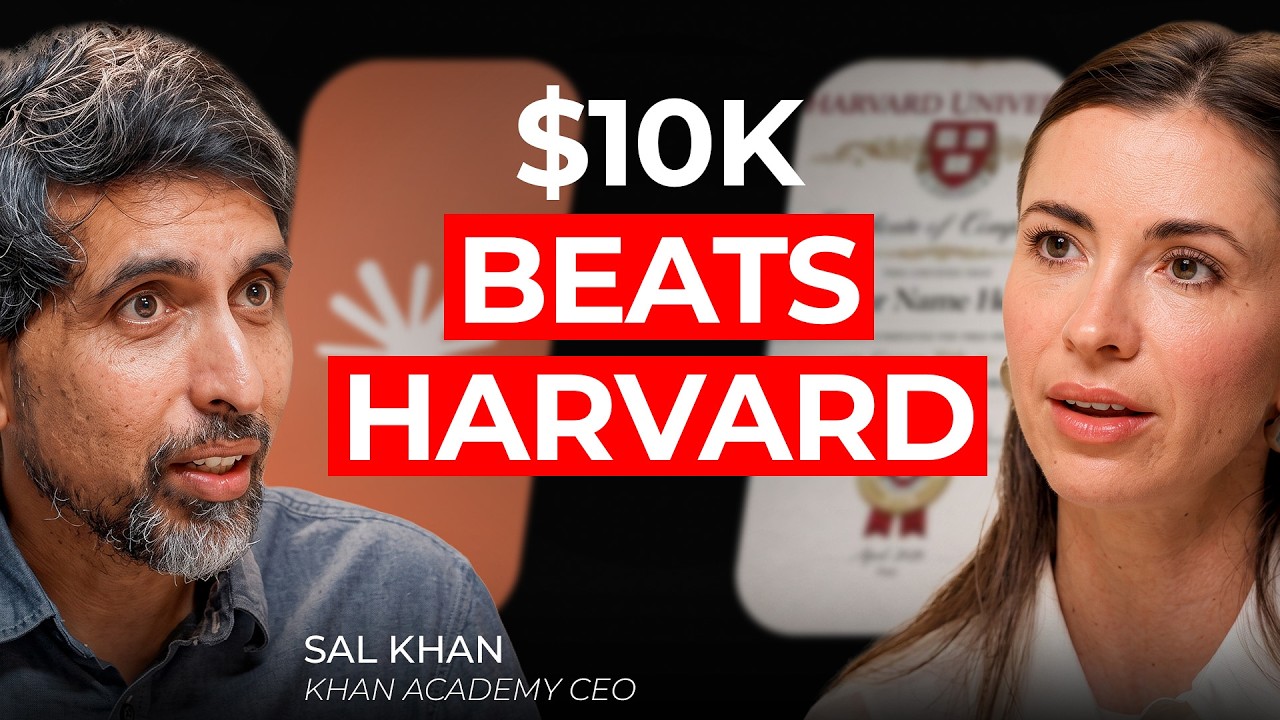
The Content Institute: a $10k degree built on durable skills
With TED and ETS, Khan is launching the Content Institute — an accredited bachelor's and master's for a maximum of $10,000 (he intends less). It combines academics with online group simulations (like building a business in four hours — prototype, ad, business plan, customer surveys) and peer review. Within two to three weeks, 3,000 people signed up, most already holding degrees and fearful they need to requalify.
- 11
A different résumé
Students complete 20 to 50 rated project simulations co-designed with McKinsey, Bain, Google, Microsoft, Replit, and Accenture, building portfolios that surface the "5 C" durable skills: communication, collaboration, creativity, critical thinking, and leadership. Khan's aim is that employers treat a top-10%-communication Content Institute grad as seriously as a top-10% elite-university graduate — replacing GPA "signals" with real evaluation and video evidence.
- 12
College is now a luxury — and there are alternatives
Khan calls elite college a "luxury experience" he'll happily pay roughly half a million dollars for his own son to have, while noting a $10k competency-based degree could take two years and free up two more for earning. He floats alternatives to a $400k degree: travel the world reading great books, seed a business, put money toward a house — or even buy a $200,000–$300,000 unautomated mom-and-pop business and have your kids automate it, private-equity style.
- 13
The real opportunity is boring industries
Asked what he'd do at 22, Khan's advice is the title's thesis: "Don't run to where everyone else is running. Try to find the lanes that are most empty — the most boring industries most ripe for applying these technologies." For individuals, he prescribes getting over the "activation energy" of trying new tools and automating your own workflows incrementally. Differentiation is still easy, he says: in 1996 "I have a web page" got you hired; today it's "I come with 100 agents" — someone who shows up that way, he'd hire at Khan Academy tomorrow. (He also warns that AI is a flatterer, so he tells it to "be critical of me.")
Chapter Breakdown
- 0:00From optimism to "Job Shock"
- 2:36The Philippines call-center wake-up call
- 3:58Driving jobs and the politics of dislocation
- 8:30Which jobs are endangered
- 10:47Which jobs are safe: the human element
- 13:53Inside Khan Academy's AI stack
- 15:45Rapid prototyping and org velocity
- 17:40AI as a chief of staff
- 20:24Is a nonprofit afraid of being cloned?
- 23:38The Content Institute: a $10k degree
- 27:19A different résumé: durable skills over GPA
- 32:18Is college worth it now?
- 41:30If you were 22 today
Prefer a narrative?
Read the full blog post