 1h 13m
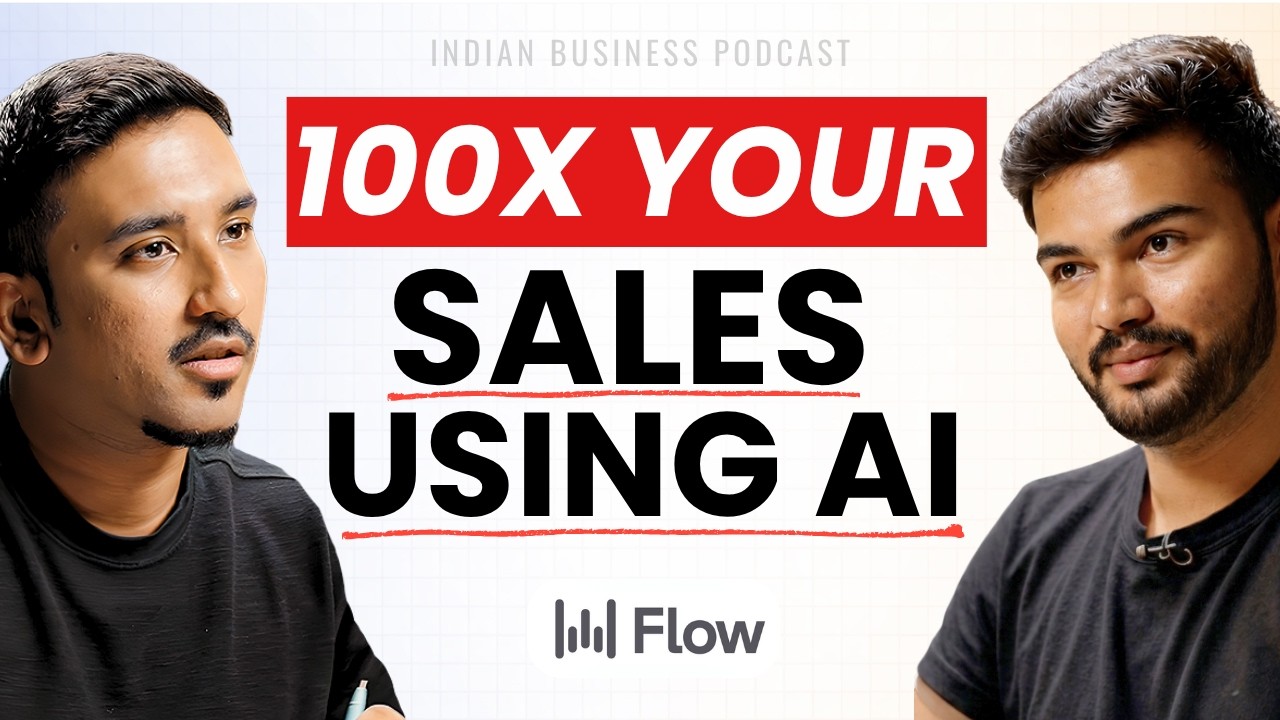
Money Machine: How 2 People Close 1,000 Enterprise Clients Every Month Using AI (Complete guide)
TL;DR
- 1WhisperFlow closes ~1,000 enterprise deals monthly with a two-person sales team.
- 2B2B sales has five steps: outreach, discovery, conversion, onboarding, post-sales.
- 3Build a 'customer discovery engine' — all data unified and queried via an LLM.
- 4Automate the repeatable parts; keep humans for new-persona discovery and checks.
- 5Automating a vertical takes about a month, not an afternoon — feed it data.
Key Insights
- 1
1,000 enterprise deals a month with two people
The headline claim: WhisperFlow — a voice-to-text AI that turns natural speech into polished writing — runs its entire enterprise sales motion with a two-person team while signing roughly 1,000 enterprise clients a month. Host Ganesh Prasad cites the company's numbers to frame the conversation: launched March 2025, 2.5 million downloads, 270 of the Fortune 500 as users (including Reid Hoffman and Steven Bartlett), and a $2 billion valuation. Tanay, the CEO and co-founder, treats these as the starting point for explaining the system behind them.
- 2
Conventional B2B sales is a five-step chain
Tanay breaks enterprise sales into five stages: outreach (finding and messaging the right buyer), discovery (learning the customer deeply so you solve their problem rather than sell a product), conversion (signing the contract), onboarding (getting the client to real value), and post-sales (support and upsell). He stresses that the process is people-intensive and that if any single stage fails, the whole chain collapses.
- 3
Onboarding is where 20–40% of clients churn
Tanay singles out onboarding as the most neglected stage. Many companies hand over an instruction manual and expect the customer to figure it out, and as a result see 20–40% of clients churn because they never found value in the product. Getting a client to the product's full value early, he argues, is what prevents that loss.
- 4
The foundation is a "customer discovery engine"
The core build is a unified analytics engine — Tanay demonstrates it on hex.tech — that connects every data source (their users, usage analytics, marketing channels, sales and support conversations) into one system powered by an LLM. Anyone in the company can query it in plain language, such as "find all power users who are VP of Engineering at companies between 500 and 5,000 people," and get an accurate list in minutes.
- 5
Product-led growth first, then draw the web
Tanay's sequence: to accelerate enterprise sales, first be a consumer-facing company with thousands of individual users, then map which companies those users sit inside and who the most influential users are within each. He adds a complementary tactic — de-anonymizing website visitors so you learn, for example, that six people from a target company visited your pricing page today.
- 6
Target the buyer who actually holds budget
Rather than cold-calling 100 random people for a ~2% response, Tanay targets the person with buying power. For engineering tools, that's the VP of Engineering, and because engineers already love the product, a curated list of heavy-usage VPs converts far better. He defines "power user" concretely (e.g. more than 20,000 words dictated) so the system can surface the best people to approach.
- 7
Hypothesis-driven selling beats hiring for experience
Asked whether this requires a veteran who has met dozens of VPs of Engineering, Tanay says no — he had never sold to anyone until six months earlier. His method is to form a clear hypothesis ("engineers love the product, so VPs of Engineering probably buy"), talk to a few such people as a blank slate purely to understand them, and let the solution become obvious. Curiosity and framing things as testable hypotheses, he argues, are the only real requirements.
- 8
Every persona needs its own playbook
What works for one buyer fails for another. Engineers, Tanay learned, hate sales calls and prefer a direct, relevant email that lets them explore themselves. Selling to a VP of Marketing differs by team size and industry — a conservative bank's CMO behaves nothing like a creative consumer brand's team. The lesson: narrow to a common persona specific enough to message at scale, and rebuild the proposition each time you move to a new segment.
- 9
Human-in-the-loop for discovery, automation for repetition
The division of labor is deliberate: automate a small, clearly-defined, verifiable task once you understand it, but keep a human for discovering each new persona — a role that needs high EQ, not a "sharky seller." Tanay describes his interview test: five minutes into a mock pitch he acts disengaged and checks whether the candidate notices and re-engages him. He says 90% of interviewees failed to even register the disengagement.
- 10
Deepen stickiness by getting customers to invest
Tanay uses the "shared dictionary" feature as an example of post-sales strategy: getting a company to teach Whisper its internal jargon, client names, and project names. Once a customer has invested that setup effort, he notes, the switching cost rises — they're far less likely to move to a competing product they'd have to customize all over again.
- 11
A live build: an AI sponsor-outreach engine for Think School
Much of the episode is a live demo where Tanay builds an outbound engine for Think School's YouTube sponsorships using Claude. He shows how a detailed prompt spins up sub-agents (in research/thinking mode) to categorize past videos, find current and similar sponsors, and match companies to video types. He walks through targeting Razorpay — whose audience of Indian business builders overlaps with Think School's, and whose pending IPO creates urgency — and finding the right point of contact rather than a generic marketing head. He recommends distilling the whole workflow into a single instruction file (a "Claude.md") and rebuilding it as a scalable app, using a no-code platform like Emergent (with a powerful model such as Opus) if you lack engineers.
- 12
Treat automation as a month-long software project, fed with data
Tanay repeatedly pushes back on the "magic wand" expectation: automating an important vertical takes about a month the first time, dropping to roughly a week once you've learned how. He advises deploying in phases — add human checks after each critical step, verify the output for the first several runs, and only then let it run autonomously. He also stresses feeding the system your own documentation so it doesn't waste tokens rediscovering information you already have. Conversion isn't automatable today, he says, but voice-agent-to-voice-agent negotiation could change that soon — which is why collecting data now matters. For hiring, he looks for someone with hands-on AI experience, personal projects that show ownership, and a computer science degree.
Chapter Breakdown
- 0:00Intro: 1,000 deals with a two-person team
- 5:31The five-step B2B sales system
- 8:44Onboarding and the churn problem
- 9:54Building the customer discovery engine
- 11:41Targeting the VP of Engineering
- 15:05Hypothesis-driven selling from scratch
- 19:55Selling to a VP of Marketing differently
- 23:59Hiring for sales: the EQ test
- 28:51Post-sales and stickiness
- 30:10Live demo: a sponsor engine for Think School
- 45:18Finding the right point of contact (Razorpay)
- 54:46Automating end-to-end with Emergent
- 59:58Timelines, hiring, and the future of conversion
Prefer a narrative?
Read the full blog post