 54m
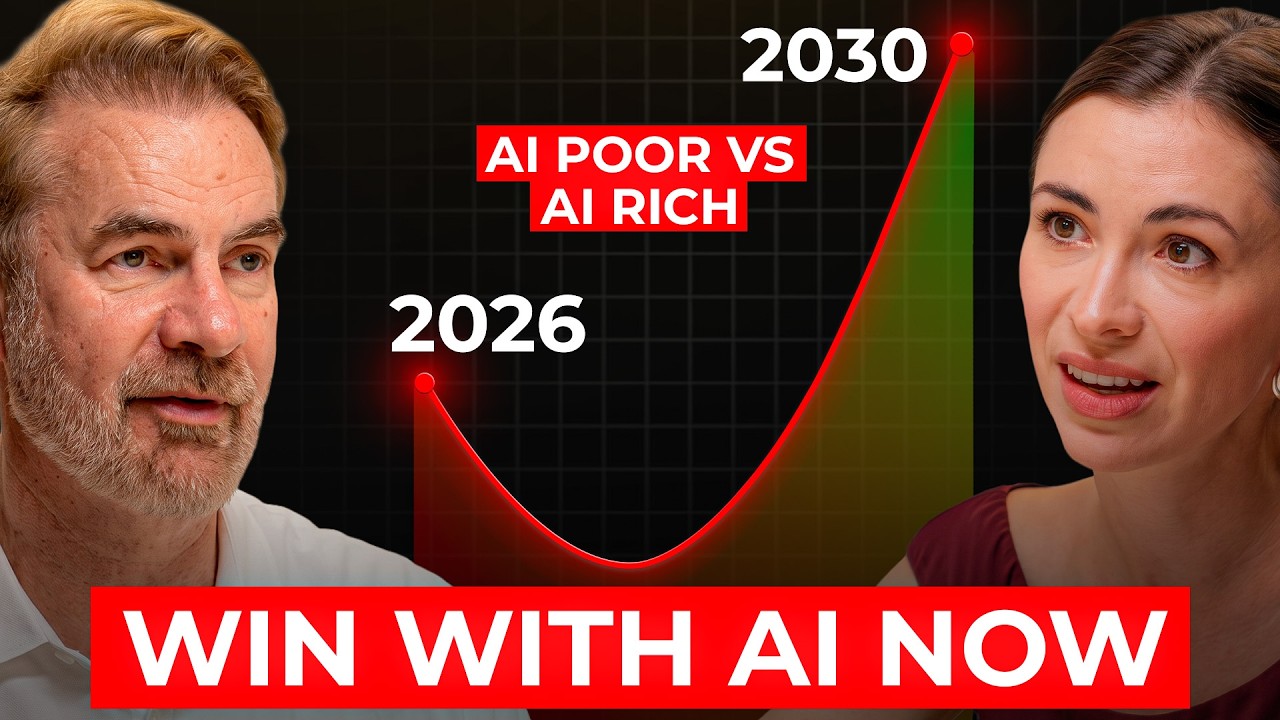
54mStanford's Top AI Economist: The Next 10 Years Will Be the Best AND the Worst in History
TL;DR
- 1AI has already erased ~16% of entry-level jobs for under-25s in exposed fields.
- 2Think in tasks, not jobs — no occupation is fully automatable.
- 3Elastic demand means cheaper AI can create jobs, not just destroy them.
- 4Future work is managing a fleet of agents — asking questions and evaluating.
- 5The next decade could be the best or worst in history; we have agency.
Key Insights
- 1
AI has already erased entry-level jobs — for the young, in exposed fields
Erik Brynjolfsson's "canaries in the coal mine" paper found roughly 16% lower employment for workers under 25 in the most AI-exposed occupations, such as coding and call centers. But the least-exposed jobs (like home health aides), older workers, and people using AI to augment rather than automate all saw growth. The declines are double-digit for those automating their work, and he says the effect keeps getting bigger every month.
- 2
Think in tasks, not jobs
Brynjolfsson argues the most useful lens is tasks, not whole occupations — every job is a bundle of them, and there isn't a single occupation where LLMs "run the table." His example: radiologists perform 26 distinct tasks; machines now read medical images, but physical exams, lab review, and coordinating care with other physicians remain firmly human.
- 3
"Everybody's a coder now"
With tools like Replit, Cursor, and Claude Code, he says every one of his Stanford students shipped running code this year — up from PowerPoint presentations the year before. Coding sits "dead center" in the exposed zone, but that same shift means anyone with an idea can now describe it and have the tools build it.
- 4
Cheaper AI can create jobs, not just destroy them
Using the economics of demand curves, Brynjolfsson explains that when demand is elastic — like air travel after cheap jet engines — lower prices lead to far higher volume and more total spending, not less. Roughly half the economy behaves this way, so AI destroys jobs in some places while creating opportunity in others. That creation half is where he focuses his energy, through his Stanford course and his startup Work Helix.
- 5
Capabilities are skyrocketing; economic impact is muted — and that gap is the opportunity
Benchmark capabilities (tracked by the Stanford AI Index) are soaring, but real productivity change is still small. Part of the reason is that companies produce "AI slop" or apply it to trivia — he cites a hackathon whose winning entry used an LLM to generate lunch menus. He expects businesses to close that gap in roughly three to five years, far faster than the ~30 years electric motors took to show up in factory productivity a century ago.
- 6
He's betting AI is underhyped
Brynjolfsson made a friendly wager with skeptic economist Bob Gordon that by 2030 productivity will be significantly higher than the government's official forecasts — and says he's already a little ahead. Higher productivity, he argues, would ease the budget deficit, poverty, and health care costs, which is why he thinks the technology is underhyped, not overhyped.
- 7
The future of work: be the CEO of a fleet of agents
Every project, he says, has three parts — defining the question, executing it, and evaluating the result. AI is rapidly mastering the middle, so most people's job will become asking the right questions and judging the output, managing not one agent but a whole fleet. It's a learnable skill that rewards combining technical ability with domain knowledge and taste; pure technical skill alone misses the problem, and domain knowledge alone misses where the tech can help.
- 8
Liberal arts are becoming more valuable, not less
Cookbook courses that teach step-by-step procedures — how to invert a matrix, say — will lose value as AI does them. Meanwhile philosophy, art, and music appreciation grow more important because they develop taste and judgment. He suggests, half-contrarianly, that universities should return to their liberal-arts roots.
- 9
Which jobs are in the bullseye
Asked to rate specific roles, Brynjolfsson is blunt: junior software engineer, mid-level marketing manager, and paralegal are all in the crosshairs — especially anything labeled "junior." Radiologist, by contrast, remains a good job. Geoffrey Hinton wrongly declared radiologists finished in 2017, yet there are now more than ever and nearly a shortage, because reading images is only part of the role and cheaper scans drive far more demand for it.
- 10
Killing entry-level jobs is a societal trap
Removing the base of the corporate pyramid turns it into a "diamond" and raises the question of where future senior people will come from — a coordination problem where each company's rational cost-cutting harms society as a whole. He praises Infosys for still hiring juniors but explicitly teaching them big-picture project skills (once learned "by osmosis"), and calls for public investment in training. He warns the AI transition is "10 times bigger" than globalization, whose backlash came from doing the disruption without helping the people it hurt.
- 11
The second machine age is bigger than the industrial revolution
The industrial revolution augmented muscle power and made us 30–50 times richer than our ancestors — what he calls the "first singularity." Now, as he argues in his book The Second Machine Age, we're augmenting our minds, which he believes will be at least as big, faster, and touch a larger share of a mostly cognitive economy. The good news is the sheer scale; the bad news is that we're not prepared for the size of the wave.
- 12
When intelligence is automated, four things stay valuable
His answer to the "trillion-dollar question" of what humans monetize once intelligence is on demand: first, initiative and agency — he reframes AI as "Amplifying Intention," useless without a plan but a huge multiplier with one; second, human connection — people still play and watch humans, prizing work that's "certified human" and authentic; third, physical trades like plumbing and carpentry, though he admits "the window's closing"; and fourth, all the jobs no one has imagined yet, which entrepreneurs will invent. He cites Reid Hoffman's point that improvisation is humanity's superpower.
- 13
Reinventing money and how we measure value
Brynjolfsson argues traditional GDP is an increasingly poor measure because zero-price goods — Wikipedia, YouTube, free ChatGPT — carry zero weight despite enormous value. His alternative, GDP-B (the B stands for benefits), asks how much you'd have to be paid to give a product up; across 600 goods it reveals trillions in hidden value, with chatbot value alone up about 70% in nine months. He foresees a future where robots make basic needs essentially free, leaving status as a key scarce good, and says the 21st century will need new economic rules the way Adam Smith and Keynes defined earlier eras.
- 14
The next decade could be the best or the worst — and we have agency
Brynjolfsson expects unprecedented wealth creation and longevity gains (citing Demis Hassabis's hope of curing most diseases within a decade), but warns of catastrophic risks: engineered viruses, AI-manipulated social media, mass concentration of power, and autonomous drones already hunting people. He's genuinely worried wealth will concentrate dangerously and floats redistribution — UBI, wealth taxes — as a backstop. But his core message is that more powerful tools mean more human agency: "think less about what AI will do to us, and more about what we want to use AI for." His parting line: "if you're not both excited and scared, you're missing at least half the story."
Chapter Breakdown
- 0:51"Canaries in the coal mine": entry-level jobs
- 2:02The most exposed fields, and thinking in tasks
- 4:24Why cheaper AI can create jobs (demand curves)
- 6:22Capabilities soaring, impact muted
- 8:02How long the payoff takes (the electricity parallel)
- 12:33The future of work: managing a fleet of agents
- 16:13Education, liberal arts, and taste
- 16:43Which jobs are in the bullseye
- 17:41The entry-level trap and the globalization lesson
- 25:36The second machine age vs the industrial revolution
- 28:00What's left when intelligence is automated
- 32:40Concentration of wealth and shared prosperity
- 38:00Reinventing money and GDP
- 48:53The J-curve, and the best or worst decade
Prefer a narrative?
Read the full blog post