 1h 8m
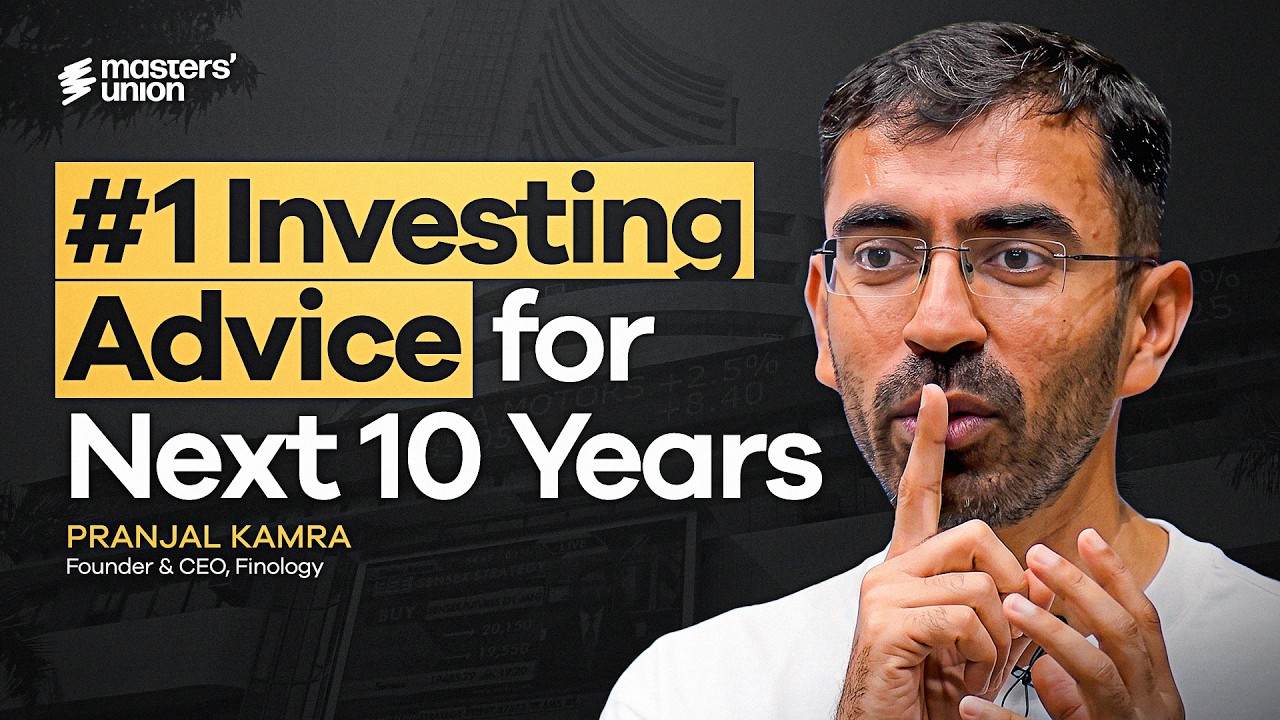
1h 8mThe Only Investment Lesson That Will Matter Most in the Next 10 Years | Pranjal Kamra, CEO-Finology
TL;DR
- 1In finance, knowing what NOT to do beats knowing what to do.
- 2In a 14% market, 90% of investors still lose money.
- 3Gambling is investing in anything you don't intrinsically understand.
- 4Don't predict the future — invest in what won't change.
- 5Money's marginal utility collapses after the first lakh a month.
Key Insights
- 1
What not to do matters more than what to do
Kamra argues that in finance and investing, always knowing what to avoid is more important than knowing what to buy — and that alone will let you outperform the market. If you simply stay away from the genuinely bad things, he says, you'll end up well without needing any clever winning pick.
- 2
In a 14%-growth market, most investors still lose money
Citing data from brokers, depositories and regulators, Kamra says that in a market growing roughly 13–14% CAGR (the Sensex's long-run return), more than 90% of investors actually make a negative return. So outperforming isn't about beating 14% — it's about beating 0%, which he calls relatively easy in a market where so much gambling is happening.
- 3
Gambling isn't the casino — it's investing in what you don't understand
Kamra reframes gambling: it's not cards or a casino, it's putting hard-earned money into anything you don't intrinsically know more about than the market does — gold, silver, even mutual funds bought blindly. If you don't know why an asset moves or how much to allocate, he says, you're at a disadvantage versus the average market, and that is gambling.
- 4
The Sunday-shoe paradox
He points to a behavioral contradiction: people will spend a Sunday visiting five stores, trying different fits and colors before buying a ₹5,000 pair of shoes, yet will put ₹50,000 into a stock on a casual tip. The care we lavish on small consumption decisions vanishes precisely where far more money is at stake.
- 5
Anything new and fancy in finance is dangerous
Kamra warns that most IPOs, NFOs, buy-now-pay-later cards, crypto and similar novelties are terrible investments, backed by crore-scale PR budgets. His logic: if 5,000 companies are already listed with well-discovered fundamentals and pricing, why would the one new IPO everyone is excited about be the best investment? In finance, he says, boring things often do really well.
- 6
Making money is simple — add value, and time only shifts by five years
There is no magical secret or thumb-rule to wealth, Kamra insists: you add value to the world and get money in return. Luck, your college, and even nepotism are real factors, but he argues they mostly change your ultimate destination by about five years — as long as you keep adding genuine value and narrowing your skill set, you'll get where you're going.
- 7
Narrow your niche until you have only ten competitors
On career growth, Kamra offers a framework: deciding to be "the best singer in the world" is overwhelming, but choosing the best qawwali or ghazal singer, then only in Hindi and Urdu, then only in live and independent music, keeps eliminating chunks of competition until you realize you have maybe ten or twenty rivals to beat. Keep doing one narrow thing great and you'll get there.
- 8
Money's marginal utility collapses after the first lakh a month
Kamra says going from zero to ₹1 lakh a month changes life phenomenally, but from ₹1 lakh to ₹10 lakh, almost nothing changes day-to-day — you live in one house, and extra money only buys more properties, offices and maintenance headaches. So there's no need to envy the infinitely rich; a good life runs fine on two-to-five crore, and you needn't chase the 50-crore figures social media pushes.
- 9
Markets are inherently unpredictable
Because every political, social and economic event worldwide has consequences that ripple into prices, Kamra argues the market moves on trillions of factors per second and is therefore inherently unpredictable — you cannot forecast it from a chart. Rather than try, he says, minimize prediction and bring predictability instead by investing in durable businesses.
- 10
Business TV inverts common sense
Kamra jokes that watching CNBC is more fun than stand-up comedy because it argues the opposite of common sense: buy a stock as it rises, sell it via a stop-loss as it falls. In no other part of life, he notes, do we buy things because they get more expensive and sell because they get cheaper — if you like something and it gets cheaper, you should buy more.
- 11
Keep mutual funds simple — and ETFs are just mutual funds
Buying a mutual fund means honestly admitting you can't pick stocks and appointing an expert for a ~1% fee, which he calls a great structure. But he warns against defeating that purpose: avoid sectoral, thematic and small-cap-only funds (which tie the manager's hands and often launch right after a sector has already run up) and choose broad-mandate funds where the manager can pivot. ETFs, he adds, are just a fancy name for mutual funds.
- 12
High margin is often a bad business
Using DuPont thinking, Kamra explains returns come from margin, volume, or leverage — and higher margin is frequently a terrible business because it invites competition to creep in, as Jio did to Airtel and Vodafone's data pricing. His pencil-seller example shows a low-margin, high-volume trader earning 100% return on equity versus a high-margin seller's 50%, while HUL's ability to sell Lux at ₹10 for decades is what keeps rivals out.
- 13
Don't value a business by headcount or revenue
Kamra says judging a company by employee count is a factory-era habit — WhatsApp reached a huge valuation with about a dozen people — and judging by revenue or turnover suits commodities, not modern businesses. He also cautions that a market leader like Colgate stays on top for 70 years less because it's a great company and more because toothpaste simply doesn't change, so leaders grow through premiumization (sensitivity pastes, mouthwash) rather than volume.
- 14
Circle of competence, "what won't change," and skin in the game
Kamra's stock framework rests on staying inside your circle of competence — Finology tracks only about 300–350 companies and ignores the other 4,700 without FOMO — and on flipping the question from predicting the future to asking what won't change in ten years (people will still brush their teeth). He argues the real edge of direct stock investing is the "knowledge alpha" from deep, multidisciplinary reading that skin in the game forces; and he pushes back hard on the retire-at-40-with-10-crore trend as philosophically hollow and financially fragile, since life is long and full of uncertainties.
Chapter Breakdown
- 1:19Why knowing what not to do wins
- 6:19The index gives 13–14%; find the winners
- 7:5290% of investors make negative returns
- 9:03Redefining gambling
- 10:32Building your first crore by adding value
- 12:52Narrowing your niche for career growth
- 19:34The collapsing marginal utility of money
- 21:06Why markets are unpredictable
- 26:37DuPont: margin, volume, and the pencil business
- 31:43Colgate, HUL, and growth through premiumization
- 33:30Why he hates government and PSU stocks
- 43:11Skin in the game and "knowledge alpha"
- 49:48Investing in what won't change
- 1:02:43The retire-at-40 critique
Prefer a narrative?
Read the full blog post