 13m
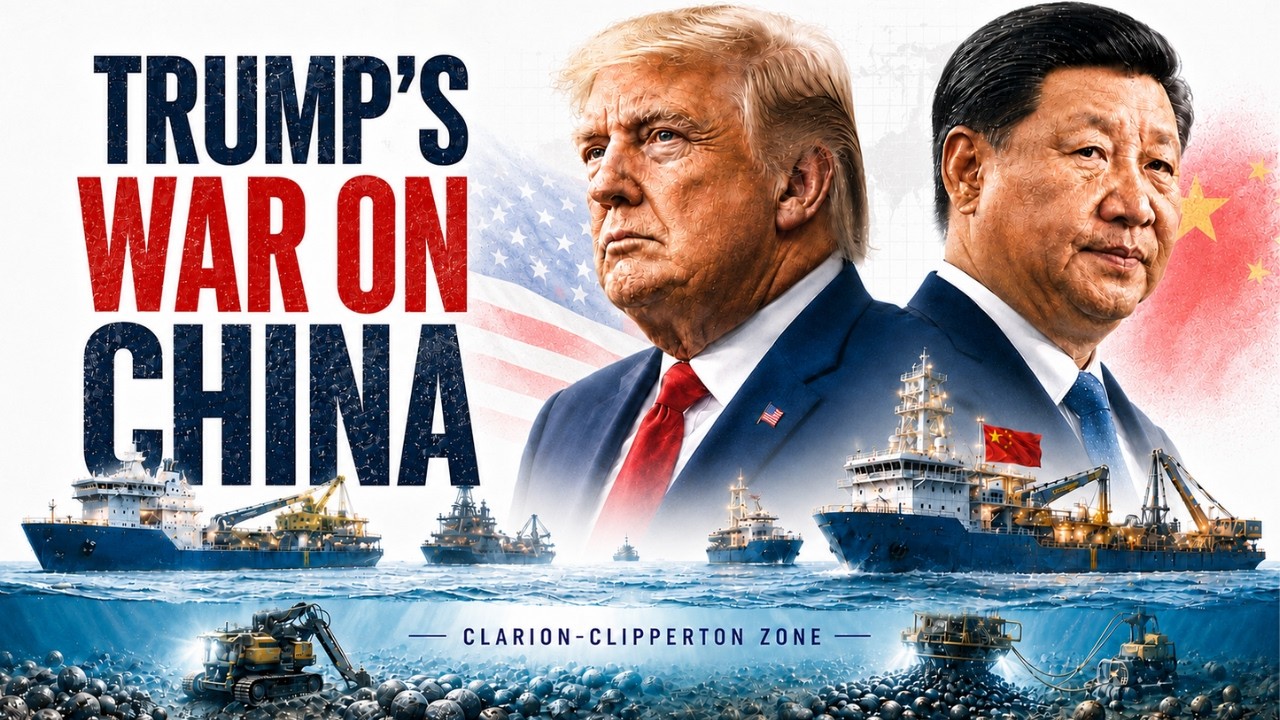
13mTrump's ILLEGAL Goldmine | Why Trump Is Breaking International Law to Beat China?
TL;DR
- 1Deep-sea nodules hold $20 trillion of four critical metals.
- 2Copper, nickel, cobalt and manganese now decide national power.
- 3The world is quietly heading into a copper shortage.
- 4China cornered all four metals' supply chains since 2008.
- 5Trump broke the Law of the Sea to mine the Pacific.
Key Insights
- 1
The commodities of power have shifted from steel and oil to four metals
Think School argues that in the 20th century, steel and oil determined a nation's strength — quoting Thomas Carlyle's line that "the nation that understands the worth of steel will reap its worth in gold." Today, the video contends, that role has passed to four metals: manganese, cobalt, nickel and copper, framed as the "infinity stones" of 21st-century geopolitics because they underpin military strength, industry, energy, technology and self-reliance.
- 2
Copper is the nervous system of a modern nation
As the world electrifies — cars, homes, factories, data centers — it needs a metal that conducts efficiently without corroding, and that metal is copper, the third most-used industrial metal. The video's chain of logic: no copper means no grid, no power, no factories, no data centers, and eventually no AI and no cities.
- 3
After 10,000 years of mining, the world is running out of copper
The video presents a widening supply gap: the world used 27 million tons of refined copper in 2024, projected to reach 33 million by 2035 and 37 million by 2050, while mine output (about 22.8 million tons in 2024) is set to peak in the late 2020s and then decline below 19 million tons by 2035. Even if every planned mine is built, it says that pipeline meets only about 70% of demand — and a new copper mine can take 10 to 20 years from discovery to production.
- 4
Manganese is irreplaceable in steelmaking
Roughly 90% of manganese goes into steel, and the video stresses there is no substitute: manganese removes oxygen and sulfur that would otherwise make steel brittle. The conclusion drawn is stark — no manganese means no steel, and no steel means no infrastructure.
- 5
Nickel and cobalt anchor stainless steel and EV batteries
About 65% of the world's nickel goes into stainless steel — the rust-free material behind surgical instruments, chemical plants and refineries — while cobalt is described as one of the most important safety metals in an EV battery, keeping it stable and stopping it from overheating. Together with copper and manganese, these are cast as the metals modern industry cannot function without.
- 6
The world isn't short of metals — China cornered the supply chain
The video is explicit that there are plenty of these metals to run the world for the next 50 years; the real problem is that China has captured all four through a deliberate strategy. This reframes the crisis from geology to control — who owns and refines the supply, not whether it exists.
- 7
China's dominance across cobalt, nickel and copper
Per the video: the Democratic Republic of Congo holds about 76% of the world's cobalt — more than the rest of the world combined — and China has bought 50% of its mines. In 2024, 60% of nickel came from Indonesia, of which China controls roughly 75% directly or indirectly, and nearly half of the world's copper is refined in or through China via smelters, ownership or investment.
- 8
With manganese, China controls the alloys instead of the mines
The video notes China neither owns the manganese mines nor relies on a single country. Instead, it dominates the alloys steelmaking depends on — producing about 67% of silicomanganese and roughly 35% of high-carbon ferromanganese — giving it a chokehold on steel production without owning the ore itself.
- 9
China accumulated this control during the world's crises
The most striking claim is one of timing: China began this push around 2008, during the global recession, and kept building through the 2008 crisis, COVID and the Russia-Ukraine war. The video's framing is that while the rest of the world was distracted by turmoil from 2008 to 2026, China quietly collected all four "infinity stones" of 21st-century power.
- 10
Asteroids are too costly, so the seabed is the alternative
The video says the chokehold has made others desperate — noting that figures like Elon Musk and NASA have seriously examined mining asteroids — but that this is prohibitively expensive, cited at $9.5 million per gram. That impossibility is what turns attention to a single Pacific patch between Hawaii and Mexico holding 21.1 billion tons of metal-rich nodules valued at $20 trillion, enough of the four metals to run the world for 50 years.
- 11
The treasure is illegal to mine — and China exploited a loophole
Under the 1982 Law of the Sea, signed by 100-plus countries, the deep seabed belongs to no one and is overseen by the International Seabed Authority; a licensee keeps 50% of an explored area while 50% is reserved for developing nations. The video alleges China gamed this: a Chinese company surveyed 148,000 km², kept half and "donated" half for developing countries — then, because China officially classifies as a developing nation at the UN, a Chinese state metals corporation contracted to mine 72,000 km² of exactly those reserved areas, donating with one hand and withdrawing with the other.
- 12
History suggests treaties don't contain the greed for resources
The video says this loophole is why Trump broke international law to authorize American companies to mine the same deep sea, starting a silent war. It then draws a historical pattern: the 1884 Berlin Conference peacefully divided Africa's resources yet preceded World War I; grand treaties calling space "the province of all mankind" didn't stop a 45-year Cold War. Its throughline — a future-defining resource, two distrustful powers, and a treaty of beautiful words — leads to the provocative closing question: oil gave the World Wars, uranium the Cold War, so what will this black rock give us?
Chapter Breakdown
- 0:03The $20 trillion "ugly black rock"
- 2:58The four metals: 21st-century "infinity stones"
- 4:26Copper, the nervous system — and its coming shortage
- 6:04Manganese, nickel and cobalt in steel and batteries
- 7:09China's chokehold across all four supply chains
- 8:22The timing: accumulating power through global crises
- 8:42Why asteroid mining isn't the answer
- 9:03The Pacific nodules — and why they're illegal to mine
- 9:56China's "developing nation" seabed loophole
- 10:48Trump breaks the law, and history's warning
Prefer a narrative?
Read the full blog post