 15m
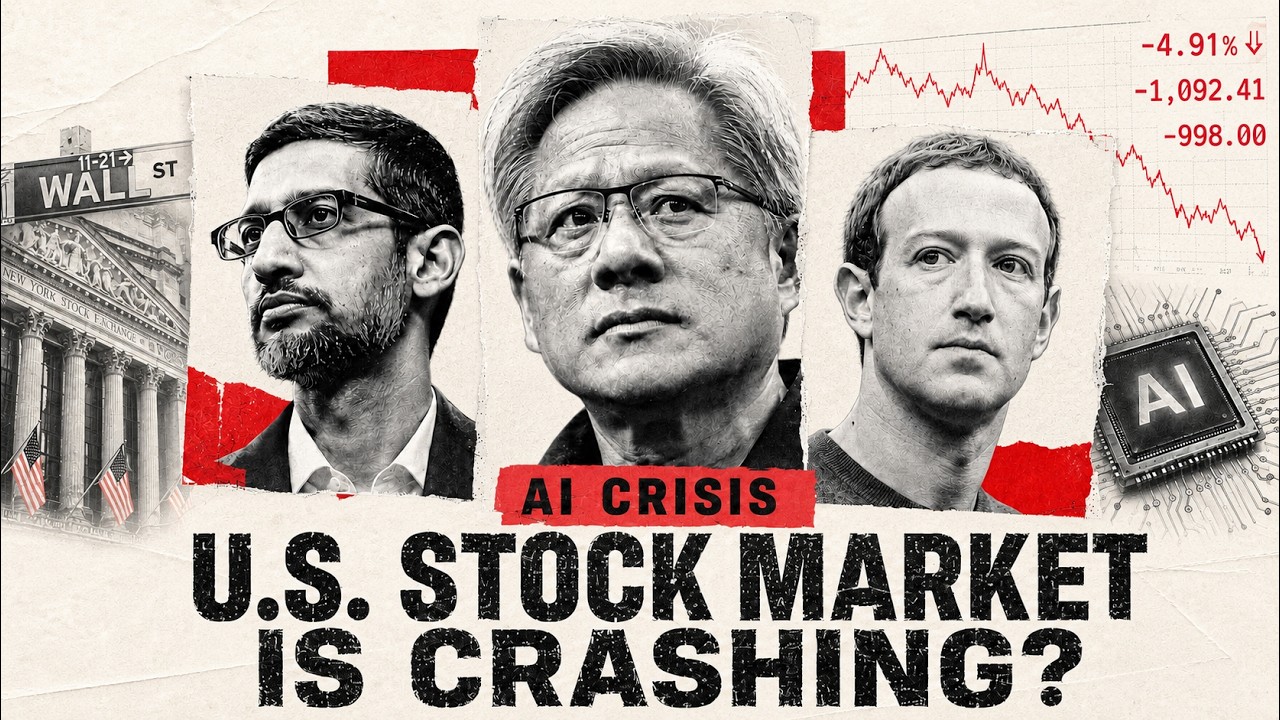
15mUS market nightmare | Why are the Tech Stocks suddenly Falling?
TL;DR
- 1US tech stocks crashed in July 2026 despite record profits.
- 2Google posted its first negative free cash flow since 2004.
- 3Nvidia's 'circular financing' ties its revenue to AI buyers' survival.
- 4Big Tech may be flattering profits by stretching server lifespans.
- 5$1.65 trillion of AI data-center debt sits in shell companies.
Key Insights
- 1
The most confusing crash in history
Think School frames the 23 July 2026 US market fall as bizarre because stocks usually crash when companies fail or slow down — but these firms did the opposite. The video says Google generated $39 billion in cash from operations yet still lost about $300 billion in market cap, while Amazon shed $120 billion and Nvidia $80 billion even without reporting that day, as panic spread that the AI boom might be cracking under rising costs.
- 2
The Google paradox: record profit, negative cash
Using a fictional coffee chain, "Brev," the video explains free cash flow: $500 million in profit minus $700 million spent building outlets leaves the bank account down $200 million despite losing nothing. Applied to Alphabet, its $39 billion in operating cash minus $44.9 billion in AI infrastructure spending produced roughly –$5.9 billion — described as Alphabet's first negative free cash flow since 2004, on top of a stated $811 billion in signed future purchase obligations.
- 3
Spending that once lifted stocks now sinks them
For years, the video notes, whenever a tech giant raised AI spending its stock rose, because spending signaled confidence. On 23 July the identical signal did the reverse — Alphabet fell 7% and Amazon 4% — marking a turning point where the market began reading heavy AI capex as a risk rather than a promise.
- 4
The math doesn't close yet
Citing a JP Morgan calculation, the video says AI needs to generate about $650 billion every year to justify a 10% return on the risk. But even assuming OpenAI at $25 billion, Anthropic at $47 billion and Gemini at $25 billion, that totals only about $97 billion — and with a combined loss of $20–30 billion — even as these firms sign contracts "left, right and center."
- 5
Vendor financing: selling on a bet, not a sale
The video illustrates vendor financing with "Dave," who sells $12,000 espresso machines for $1,000 down and the rest "only when you make a profit." His revenue explodes to $1.2 million overnight, but he hasn't made 100 sales — he's placed 100 bets that cafes selling ~200 cups a day will somehow sell 20,000. If they don't, the video says, his record revenue simply vanishes.
- 6
Nvidia's circular financing loop
Scaling that up, the video reports Nvidia is in talks to provide a ~$250 billion financing guarantee to OpenAI for a data center (part of a $500 billion-plus SoftBank-built project) plus a separate chip-procurement deal up to $350 billion — roughly $600 billion of exposure to OpenAI against Nvidia's own $216 billion annual revenue. Money flows in a circle: Nvidia guarantees financing, OpenAI leases compute and buys Nvidia chips with it, Nvidia books the revenue, then backs even more projects — leaving Nvidia as supplier, investor and debt guarantor at once.
- 7
Risk one: can the buyer actually pay?
The first risk the video names is whether buyers can pay from profits. OpenAI has reportedly signed around $1.4 trillion in infrastructure commitments against roughly $25 billion in annual revenue, and Sam Altman has publicly admitted the company loses money even on $200 Pro subscribers. The video balances this by noting that if OpenAI drives costs down and turns profitable, it could become the greatest company on Earth.
- 8
Risk two: the depreciation accounting trick
The video credits investor Michael Burry with spotting an accounting lever: how long a company says its servers will last changes its reported cost. A $30 billion server fleet depreciated over three years books $10 billion a year, but stretched to six years books only $5 billion — instantly lifting reported profit by $5 billion. Per a table the video attributes to Burry, Meta moved useful life from 3 to 5.5 years and Google from 3 to 6 years between 2020 and 2025, with Oracle and Microsoft doing similar — a claim the video says only time (around 2028) will settle.
- 9
Risk three: shell companies hiding the debt
With the AI data-center build-out priced at over $3 trillion (or $5 trillion including power plants, per JP Morgan), the video asks where the money comes from — and answers: borrowing through shell companies. Its example is a $29 billion Meta data center funded not by Meta directly but by a newly created shell entity that borrowed $27.3 billion from bond investors due in 2049, with Meta as a 20% owner and rent-paying tenant. This structure, it says, is how Meta, Alphabet, Amazon, Microsoft and Oracle collectively carry $1.65 trillion in AI-related debt.
- 10
Risk four: the insurance market is getting scared
The video's final risk is systemic: if profits don't materialize, Nvidia could lose revenue, equity value and loans all at once. It explains credit default swaps as insurance on debt, and notes that on 27 July 2026 — as OpenAI news broke — the price of insurance on Nvidia's debt recorded its biggest intraday jump. Its framing: the stock market shows what people hope for, while the insurance price shows what they fear.
- 11
It all hinges on token costs
The video ties the threads together — Google's cash problem, Nvidia's circular financing, the depreciation math, the hidden debt and high oil prices — as a combined paranoia explaining the fall. The deciding variable, it argues, is the cost of AI tokens: if it keeps dropping dramatically for the next three years as it did in the last three, enterprises adopt AI everywhere, the labs turn profitable and Nvidia's projections come true. The creator calls it difficult but believes that if anyone can pull it off, it's OpenAI, Anthropic and Google.
Chapter Breakdown
- 0:10The most confusing crash in history
- 3:06The Google paradox and free cash flow
- 4:47Why AI spending suddenly scares the market
- 5:06JP Morgan's $650 billion math
- 6:11Vendor financing, explained with espresso machines
- 7:41Nvidia's circular financing loop
- 8:55Risk one: can the buyer pay?
- 9:46Risk two: the depreciation accounting trick
- 11:18Risk three: shell companies and $1.65T debt
- 12:44Risk four: credit default swaps and fear
Prefer a narrative?
Read the full blog post