 28m
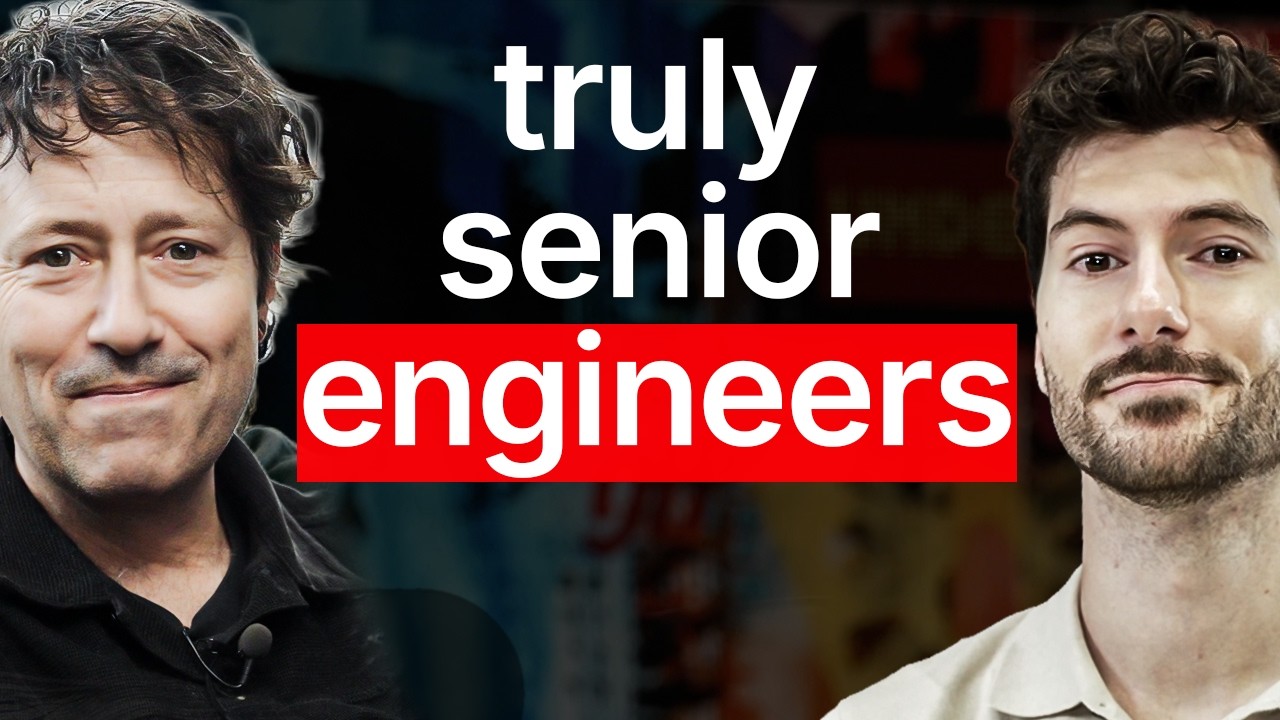
28mWhat Senior Engineers do Differently (Vercel VP)
TL;DR
- 1The best engineers unblock themselves — and proactively unblock others.
- 2They systematize their help, leaving reusable 'skills' that scale their impact.
- 3Agents consolidate roles; everyone's 'a junior engineer again,' so stay hands-on.
- 4Ask AI first, then bring grounded, skeptical questions to experienced people.
- 5Go back to fundamentals, write to distill, and seek feedback early.
Key Insights
- 1
What the best engineers actually do differently
Asked to describe the strongest engineers he works with, Lindsey Simon's answer is direct: they are exceptional at unblocking themselves, and just as good at proactively unblocking other people. They stay in touch with what's happening across the company — reading, writing, and helping — and, crucially, they systematize that help, leaving a "breadcrumb" that will unblock the next ten people. That, he says, is how impact scales at senior levels.
- 2
Systematizing help into reusable "skills"
His concrete example: a Vercel engineer (Shu Ding) codified years of hard-won React best practices — debugging async fetches, handling instant mutations on client and server — into a reusable "skill." Once distributed, that single artifact extended his impact to an industry level. Simon sees the emerging ecosystem of shareable skills and plugins as a powerful new way for one person's expertise to scale far beyond their own keyboard.
- 3
"We're all junior engineers again"
Because AI tools haven't existed longer than anyone has been in the industry, Simon says the FOMO everyone feels is real and shared. You can hide out of fear, but "the only way out is through." What drew people to build in the first place — the craft of making things you'd want to use and share — hasn't gone away, and he says he's more motivated to build now than ever.
- 4
Roles are consolidating, not disappearing
Simon doesn't expect roles to vanish so much as merge. Agents let you work effectively in areas you're less trained in, dissolving the old engineering-manager / product-manager / designer "lanes." He points to the valley trend of everyone becoming a "member of the technical staff" — part anti-poaching cover, part a genuine flattening where you can do design without being a designer by trade.
- 5
Level doesn't matter — impact does
Tech's egalitarian, meritocratic appeal is intact, Simon argues. At Vercel, interns present at Friday demo days in front of the founder, CTO, and the whole engineering team, and everyone is equal in that room. "It doesn't actually matter what your level is — you could impact the business if you figure out the thing, if you spend the time."
- 6
Why early-career engineers are thriving
Rather than pitying juniors, Simon would happily hire them. They've grown up "builder-minded," unburdened by the assumption that you need specific expertise before attempting something — bold enough to think "I don't know anything, so I may as well do everything." A new grad with four relevant years of hackathons and internships, he notes, may be better prepared than someone with six years of less-relevant experience.
- 7
Ask the agent first — then ask a human better
Traditional education trains you to figure things out alone; the workplace rewards asking when you're truly stuck. Now, Simon observes, you can ask an agent first, and when its answer looks "fuzzy or generic," bring a sharper, grounded question to an experienced colleague. That framing — "I tried to unblock myself and I'm not satisfied with the answer, here's why" — is a far better way to ask for help, and people respect it.
- 8
The real skill is questioning and skepticism
Simon prizes the habit of digging backwards — repeatedly asking "why is that the answer?" — to build a fundamental understanding of the problem space. He draws an analogy to evaluating search sources (something his 10-year-old daughter is now taught in school) and stresses trusting AI results while staying skeptical and validating with peers. Knowing when to push back, he says, only comes from having built that understanding.
- 9
IC and management are parallel, not a ladder
Vercel deliberately avoids equating management with leadership. The highest individual-contributor level is as high as the highest management level, so choosing to stay hands-on carries no career ceiling. Simon notes that the people who actually lead and drive innovation tend to be the ones building — connected to the iteration cycle and talking to customers rather than delegating that away.
- 10
Don't blame the user — fix the friction
Building for famously fickle engineers, Simon weighs both social signal and telemetry, since people "vote with their feet and with what saves them time." On harsh feedback his stance is generous: "if they're not wrong, nobody's wrong here — if we think they're wrong, then we didn't communicate it well." He describes watching a user struggle silently through a product as "knuckle-whitening," but the single most motivating thing there is.
- 11
Go back to fundamentals, write to distill, seek feedback early
His prescription for leveling up starts with closing the gaps you skated past — the "85 on a test" that grows into splinters — so you can build on stronger foundations, think clearly, and move faster. He calls for a resurgence of liberal-arts education: "if English is the most important programming language, you'd better learn how to write," because distilling information matters even more when working with AI. His single biggest takeaway: don't disappear "into the cave" hoping to emerge with something earth-changing — get feedback early and continuously, and learn to write about your work, which turns experiments into concise descriptions others actually value.
Chapter Breakdown
- 0:00FOMO and the drive to prove yourself
- 1:51Agents: roles consolidating, not disappearing
- 3:37The flattening of hierarchy
- 4:31Why early-career engineers excel
- 6:17Asking questions in the agent era
- 8:06Questioning, skepticism, and fundamentals
- 9:38"We're all junior engineers again"
- 10:22IC vs. management, and finding fulfillment
- 14:44Building for fickle engineers; feedback
- 18:08How expectations evolved: scope of impact
- 20:43What the best engineers do differently
- 22:27Learning how to learn; liberal arts
- 27:00Final takeaway: feedback and writing
Prefer a narrative?
Read the full blog post